DEITY OF CHRIST

Friday, October 28, 2016

The Error of Baalam

The Way of Balaam

Peter warned against “the way of Balaam,” Jude against “the error of Balaam” and John against “the doctrine of Balaam” (II Peter 2:15; Jude 11; Revelation 2:14). God evidently considers these warnings necessary and appropriate for Christians even today.
Yet Balaam, in his day, was a genuine prophet (note II Peter 2:16), possessed great knowledge concerning God, and even received direct revelations from God. What, therefore, were his way, his error, and his doctrine?
  • “The way of Balaam” was a readiness to prostitute his high spiritual gifts and privileges for “The wages of unrighteousness” (II Peter 2:14), being willing to preach something contrary to God’s Word for personal gain.
  • “The error of Balaam” was evidently his willingness to compromise his own standards of morality and truth in order “greedily” to accommodate those of his pagan patrons (Jude 11).
  • Finally, “the doctrine of Balaam,” which even in John’s day was already infiltrating the church, was to use his own teaching authority to persuade God’s people that it was all right for them also to compromise these standards, even “to commit fornication” (Revelation 2:14) with their idol-worshipping enemies.
No wonder Micah (the faithful prophet) urged God’s people to “remember” Balaam and his tragic end (Numbers 31:8). 

Source: https://bible.org/illustration/way-balaam

Monday, October 10, 2016

David Pawson: Micah (Unlocking the Bible Series)

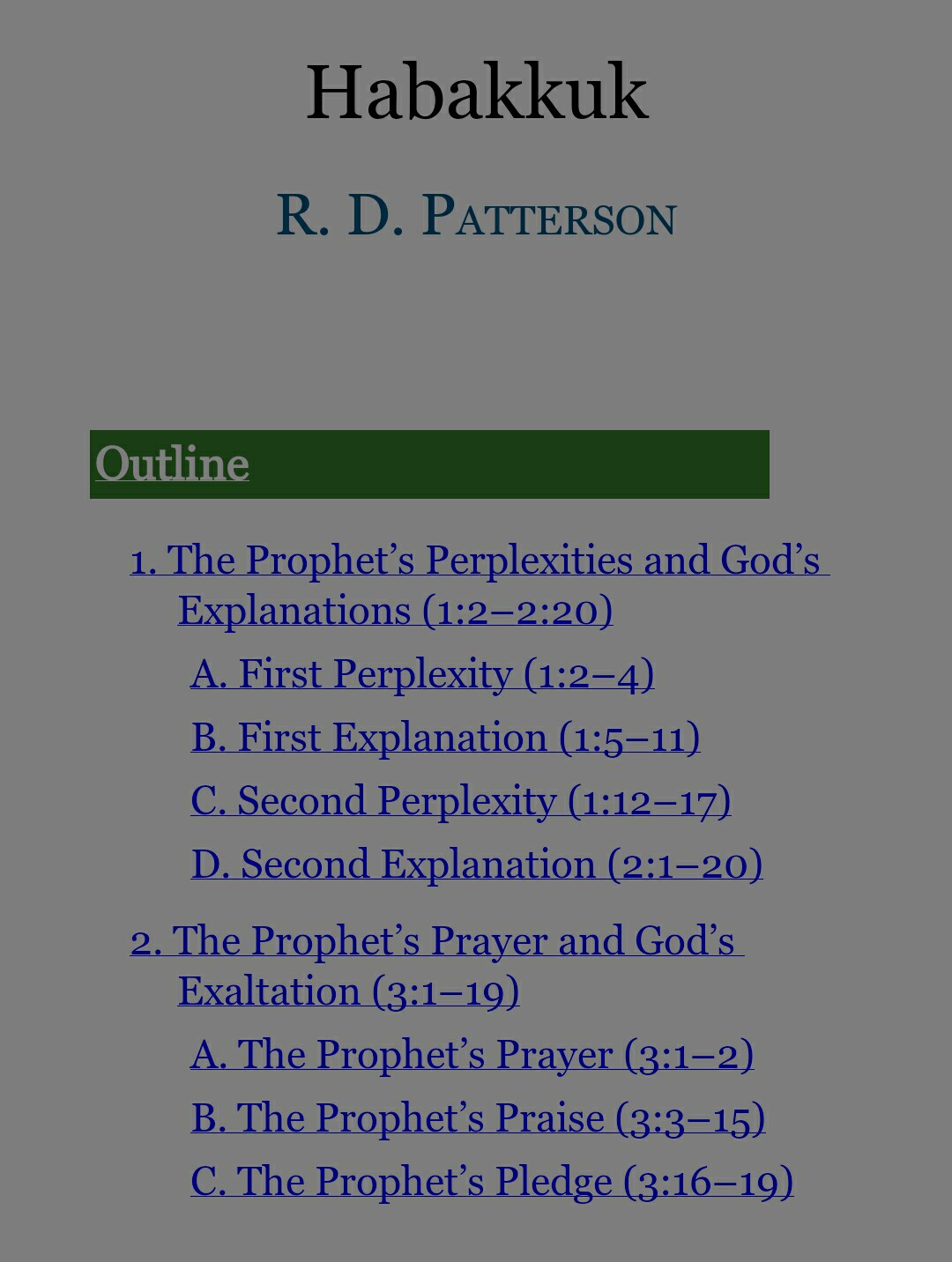
Gist of Habakkuk

"Nevertheless, the unity and single authorship of Habakkuk can be demonstrated from at least three conclusive facts. First, a common theme runs throughout the prophecy, namely, that God sovereignly controls the affairs of history. Second, demonstrable points of internal dependence and relation exist between the various portions,such as Habakkuk’s patient waiting on the Lord (2: 1–3, 20; 3: 2, 16–19), his consistent portrayal of the godless (1: 4, 13; 3: 13), his reception of the Lord’s answer to his perplexities (1: 5; 2: 2; 3: 2, 16), and his confidence that the Lord will not utterly destroy his people (1: 12; 3: 1–2, 16–19). Finally, only with the closing verses of the third chapter is there a satisfactory answer to all of the prophet’s uncertainties."
The ending poetry which depicts the sufficiency of God and the joy which can be had in spite of the lack of everything else, the Lord being his strength encourages us to focus on God as the source of our strength, the one who strengthens us during difficult times and draws us higher to live by faith.
17Although the fig tree shall not blossom, neither shall fruit be in the vines; the labour of the olive shall fail, and the fields shall yield no meat; the flock shall be cut off from the fold, andthere shall be no herd in the stalls:
18Yet I will rejoice in the LORD, I will joy in the God of my salvation.
19The LORD God is my strength, and he will make my feet like hinds' feet, and he will make me to walk upon mine high places. Habakkuk 3 


Thursday, September 29, 2016

Mercy as the lens for interpreting the Torah

"In both of these passages, Hos 6.6, with its emphasis on mercy, is put forward as a hermeneutical lens through which the Torah is to be interpreted: the Pharisees go astray in their understanding of the Law because they fail to realize that its central aim is mercy. Alongside these passages should be placed the beatitude, ‘Blessed are the merciful, for they shall receive mercy’(Matt 5.7), and Jesus’pronouncement that ‘the weightier matters of the Law’are ‘justice and mercy and faith’(Matt 23.23). In such passages the quality of mercy is not set in opposition to the Law; rather, Matthew’s Jesus discerns within scripture itself the hermeneutical principle –expressed epigrammatically in Hos 6.6 –that all the commandments are to be interpreted in such a way as to engender and promote the practice of mercy among God’s people. Thus, the story of Israel is carried forward through a particular construal of Torah within a community called to embody the mercy of God."
~~ Cambridge companion to the Gospel 

Tuesday, September 27, 2016

VENGEANCE OF GOD

"Vengeance in the Old Testament is a juridical term involving the righting of wrongs that have been done. Earlier, Nineveh experienced God’s grace because they had repented. Now they will experience his vengeance. The outpouring of God’s wrath has been delayed, not because he does not care or because he was helpless to act, but because he is patient and slow to anger. The fact that Nineveh is not specifically mentioned in chapter 1, yet seems clearly to be in view, indicates that she serves as an example of the way God deals with his enemies in general. He will not leave the guilty unpunished. This is quoted from Exodus 34: 7 and forms the necessary counterpoint to God’s grace as described in Exodus 34: 6. The nation or individual who rejects God’s forgiving grace will of necessity experience the outpouring of his wrath. God will have the last word. A Jonah may be impatient with God for sparing a Nineveh for a time, but God’s people may rest confidently in his determination and power to deal with sinners in his own time and way. The awesome and irresistible power of God is displayed in nature (1: 3b–6). If the most powerful forces of nature are at God’s disposal to be used as his instrument of judgment, and if no area of creation is immune to the fierceness of God’s wrath, how will any person or kingdom be able to withstand God’s judgment?"
~~ Commentary on Nahum, Baker's Illustrated Commentary of the Bible .